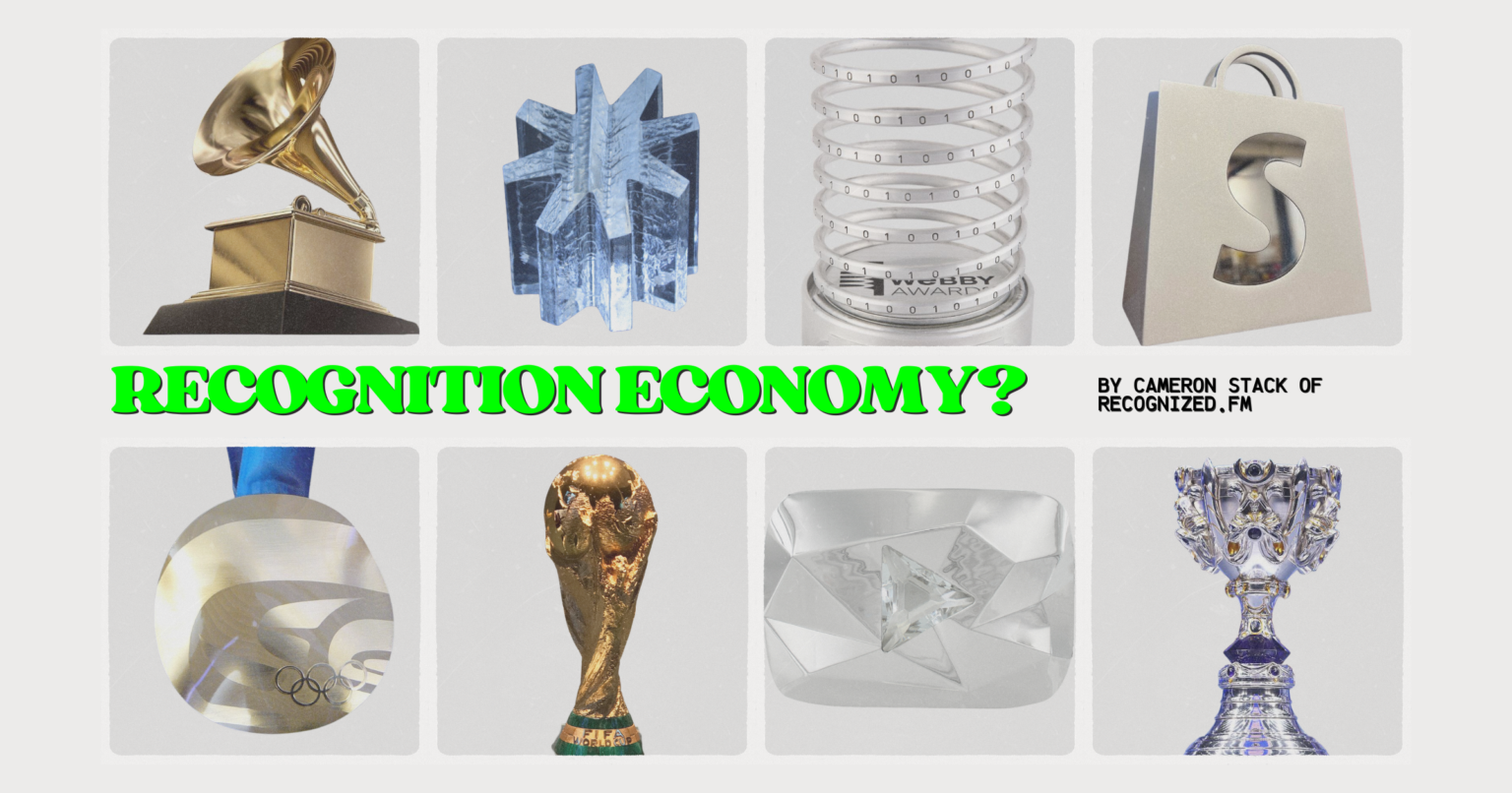
The Academy of Motion Picture Arts and Sciences brought in $150.5 million from the Oscars and related activities in fiscal 2025. A single Best Picture Oscar campaign can run into the tens of millions, with some campaigns reaching $25 million to $30 million. FIFA projects about $13 billion in revenue across its 2023–2026 cycle, with 2026 World Cup earnings expected to exceed $10 billion. The Webby Awards charged entry fees ranging from $125 to $865, with several common categories in the roughly $475 to $695 range, and received nearly 13,000 entries from over 70 countries. Haymarket Media Group, a private British company with more than 80 brands and about £183 million in annual turnover, runs B2B award programs through outlets like Campaign and PRWeek.
These organizations do not think of themselves as interconnected, but in a way, they are connected more than they think. They belong to what others have hinted at and what I have coined “The Recognition Economy.” It is built around awards, rankings, championships, badges, and public acknowledgment across overlapping industry sectors.
At its simplest, the recognition economy is about how recognition is given and how that status can convert into value. It includes the institutions that create recognition, the channels that spread it, and the markets where that recognition turns into trust, visibility, and money.
It is easy to dismiss this as decoration. A trophy, a badge, a ranking, a list. Nice to have, but not the main event. Except the main event is often the money. Awards can shape hiring, pricing, sponsorships, investment, trust, and access. In practice, a title or badge can work like a shortcut in a crowded market. In the right hands, it is an economic asset.
The same pattern shows up across very different fields.
Broad industry and niche community honors that recognize a person, group, or work for achievement, merit, excellence, or another distinction, typically granting status, legitimacy, and exposure to wider attention.
Large-scale athletic competitions that determine winners and generate commercial activity through broadcasting, sponsorship, and tourism.
Specialized communities run their own competitions to determine champions within their niche skill or activity.
Recognition awarded automatically when a measurable performance threshold or milestone is reached, rather than by selection.
Editorial lists published by media outlets that name selected people, companies, or work.
Software that companies use to deliver employee recognition, rewards, and related analytics across teams.
Platform badges used in marketplace and gig platforms to signal provider performance, trust, or access to benefits.
The recognition economy is bigger than prestige television or global sports, and that is part of what makes it easy to miss. The same basic pattern shows up in workplaces, local markets, online platforms, and professional communities. Some systems hand out employee awards. Some publish local best-of lists. Some offer platform badges that signal trust or performance. Others run large award programs that attract thousands of entries and real spending.
In every case, the value comes from the recognition itself, not just the underlying skill. The signal says this person, team, company, or work has been validated.
There is no standard definition for the term and no trade body that governs the whole space. Some parts are old. Trophy-making, award ceremonies, and rankings have existed for decades. But the scale is easy to miss. It includes the Oscars, Grammys, Emmys, BAFTAs, Pulitzers, James Beard Awards, CES Innovation Awards, and Cannes Palme d’Or, along with thousands of smaller signals that still carry real economic weight.
The problem is that the signals are rarely transparent. A best-of list might reflect genuine community judgment, or it might be partly a sponsorship product. A platform badge might indicate strong performance, or it might mostly reflect loyalty to the platform’s system. A certification might be rigorous and portable, or it might be little more than a marketing credential. Outsiders usually have no easy way to tell the difference.
Scholars have begun examining why this matters. Asante, Sarpong, Bi, and Mordi (2023) notes that business excellence awards have become a fixture of organizational life, yet the academic work examining them remains scattered, with most attention fixed on what they call “the intense obsession with award ceremonies” (Asante, (2023). Their framework traces how competitive pressure and the pursuit of advantage push firms to enter these contests, and what happens to those who win or land on the shortlist.
Bruno S. Frey (2007) offered a broader lens. He defines awards as “non-material, extrinsic compensation taking the form of orders, medals, decorations and prizes“. Monarchies used them. Republics used them. Corporations use them now. For all their prevalence, Frey observed, awards had drawn remarkably little serious study. Later research by Frey and Gallus expanded the inquiry, observing that awards “cater to the fundamental desire for social recognition.” They work as incentives because they tap something deeper than money. But measuring the effect is difficult because awards are designed to go to the best performers, which makes it hard to separate motivation from selection.
The companies behind these programs understand the business. Haymarket Media Group has built a serious operation around selling recognition and access. The Webby Awards rely on entry fees, sponsorships, and the value of the credential itself. Inside companies, platforms like O.C. Tanner’s Culture Cloud and Workhuman have turned recognition into enterprise software.
Recognition works partly because it reduces uncertainty; it tells people what is worth noticing. Lagios and Méon (2023) tested this directly by studying France’s most prestigious literary award, the Goncourt. Using a regression discontinuity design, they found that winning boosted sales, increased the number of Amazon reviews, and raised the share of negative ones. The prize, they concluded, acts as “a quality signal and a coordination device” (Lagios and Méon (2023). It tells people a book exists and suggests it is worth reading. But it also pushes consumers toward books far from their usual tastes, which explains the complaints.
The recognition economy is now built into how modern status is created, spread, and traded. It shapes what films people watch, which companies they trust, which professionals they hire, and which creators they follow. The bigger question is whether this system stays opaque, or whether it eventually develops shared standards for what recognition actually means. That is not just an academic question. It is a market question. And for now, the market is still acting as if the answer does not matter.
Frey, Bruno S. “Awards as Compensation.” European Management Review, vol. 4, 2007, pp. 6–14, https://doi.org/10.1057/palgrave.emr.1500068.
Frey, Bruno S., and Jana Gallus. “Towards an Economics of Awards.” Journal of Economic Surveys, vol. 31, 2017, pp. 190–200, https://doi.org/10.1111/joes.12127.
Lagios, Nicolás, and Pierre-Guillaume Méon. “Experts, Information, Reviews, and Coordination: Evidence on How Prizes Affect Sales.” The Journal of Industrial Economics, 2023, https://doi.org/10.1111/joie.12347.
Asante, S., Sarpong, D., Bi, J. & Mordi, C. (2023) Collecting badges: Understanding the gold rush for business excellence awards. European Management Review, 20(1), 18–30. https://doi.org/10.1111/emre.12512
No results available